

Two experiences over the last week reminded me that national service in America needs a major jumpstart.
The first was a 27-station television and radio tour I did across America, reflecting on the post-9/11 commitment to service, that reminded me of the goodness, decency and can-do spirit of the American people. The second was a party at the home of national service architect Shirley Sagawa celebrating two civil servants (Sandy Scott and Rhonda Taylor) who collectively worked in government for 80 years to advance national service and volunteering. I thought of how far we have come and how far we must go to realize the potential of this big idea that could help heal a divided nation.
In TV and radio shows on the 25th anniversary of 9/11, I heard Americans sharing how September 11 lifted them out of their ordinary lives to do extraordinary things for neighbor and nation. And how they worked with people of different faiths, politics and other divisions. They did not wait to be told that citizenship carried responsibilities. They simply jumped in to help.

That spirit reminded me of when conservative commentator William F. Buckley came to The White House after 9/11, handed me his book entitled Gratitude, a case for large-scale national service, and quoted from it:
“Materialistic democracy beckons everyone to be a king; Republican citizenship incites everyone to be a knight.” We all want to be knights.
The story of national service in the United States is one of peaks and valleys. But at every peak, something important has happened: Americans were asked to do more than they thought possible, and government and the nonprofit sector created the means for them to answer the call.
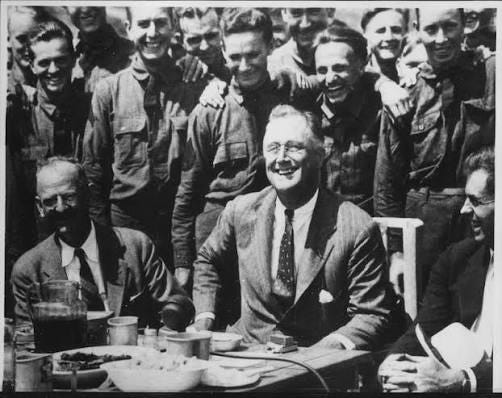
Franklin Roosevelt demonstrated this during the Great Depression. Within months of his inauguration, the Civilian Conservation Corps had begun putting young unemployed Americans to work. Over its lifetime, the CCC enrolled roughly three million men. They planted more than three billion trees, built thousands of fire towers and tens of thousands of miles of roads and trails, fought fires, restored landscapes, and improved public lands. The National Park Service credits the CCC with work affecting more than 84 million acres of agricultural land – equivalent to our national park footprint today -- and helping establish more than 800 parks and recreation areas.
FDR showed that large-scale national service could happen.
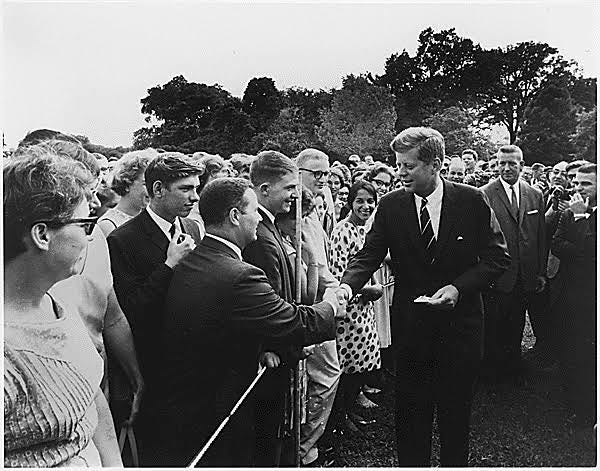
John F. Kennedy showed that service could reach beyond our shores. Building on earlier proposals, including Harry Truman’s call for a four-point youth corps, and proposals in Congress, Kennedy created the Peace Corps. Since 1961, more than 240,000 Americans have served for two years in 144 countries. A survey of 11,000 Returned Peace Corps Volunteers showed that 62 percent believed such service increased America’s national security and a remarkable 98 percent would recommend Peace Corps to their loved ones.
The parade of additional innovations in national service would continue.
Lyndon Johnson created Volunteers in Service to America to tap American talent in the War on Poverty. Johnson and Richard Nixon expanded service opportunities for older Americans, giving citizens an encore of service. Jimmy Carter supported the growth of Habitat for Humanity. Ronald Reagan promoted private-sector initiatives and volunteering, calling the American spirit of voluntary service “a deep and mighty river flowing through the history of our nation.”


George H.W. Bush created a national commission and launched the Points of Light initiative to pilot national service and fuel volunteer service. Bill Clinton created AmeriCorps, which helped provide grants and people to nonprofits such as Teach for America, City Year and YouthBuild.


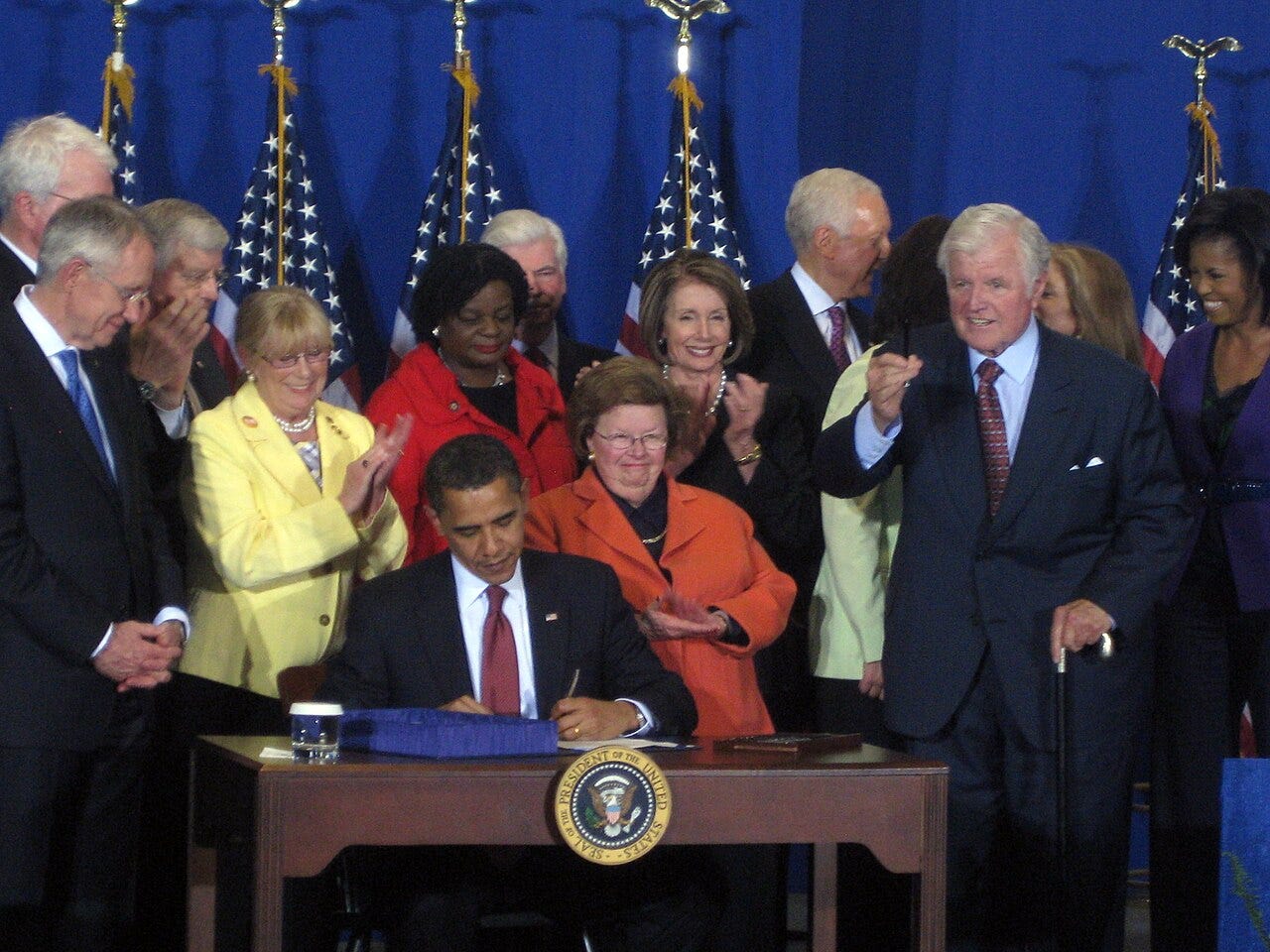
George W. Bush expanded these national service programs after 9/11 to their highest levels then and since and created new disaster-response initiatives such as the Medical Reserve Corps, Fire Corps, and Citizen Corps in every state, while expanding Community Emergency Response Teams, Volunteers in Police Service, and Neighborhood Watch. Barack Obama signed the bipartisan Edward M. Kennedy Serve America Act into law, which promised to grow national service even further.


Different presidents. Different parties. Different challenges. But the same underlying proposition: America is stronger when Americans are called to serve one another across our differences.
And then came the decline.
National service has been declining or flatlining in many of these programs. After reaching more than 500,000 participants in Senior Corps after 9/11, Senior Corps places just over 140,000 Americans today. The Peace Corps is less than half its post-9/11 peak and a fraction of its historic high of 15,500 in 1966.
AmeriCorps itself has faced profound organizational and staffing disruptions and struggled to maintain post-9/11 levels of 75,000 members. Without Ann Maura Connolly and Voices for National Service, the program may have disappeared.
Programs such as Learn and Serve America that helped young people ground their learning in service have vanished. The Volunteer Generation Fund created by President George W. Bush after 9/11 to strengthen the capacity of communities to recruit and retain volunteers is no longer funded.
The problem is not that Americans have lost the capacity to serve. The problem is that we have not built enough avenues for them to do so.
How, then, can the 25th anniversary of September 11 usher in more than an occasion for remembrance? How can it become an occasion for renewal?
Vice President JD Vance, before he was in his current position, once said to me, “National service is the best idea that never happens.” At some level, he is right. But it does not have to remain that way. We need to be honest about where we are and learn lessons from the past to plot the future.
Here are five concrete suggestions to help fuel a new national service movement.
1. Implement and Fund the Kennedy Serve America Act
The bipartisan Serve America Act reflected an important insight: small agencies such as the Peace Corps and the Corporation for National and Community Service could never, by themselves, have budgets large enough to expand national service to the scale necessary to move the culture.
The Serve America Act envisioned broader service corps and partnerships across the federal government. Federal law contemplated projects involving departments and agencies ranging from Agriculture, Interior, Health and Human Services and Transportation to FEMA, Energy and Veterans Affairs. All these agencies have needs that human talent can meet; all have large budgets; and FEMA Corps demonstrates that national service can often perform work at lower cost to taxpayers.
The larger lesson is straightforward: national service cannot remain the responsibility of one small corner of government.
If we want national service to become a national institution, we need a much broader field of allies—leaders in nonprofits, businesses, philanthropies, colleges and universities, veterans-serving organizations, and departments and agencies, together with Governors and Mayors – that will advocate for national service across federal, state, and local governments and the private and nonprofit sectors.
2. Support Governors in creating Service-Year Options and Fellowships
Governors can help build the bridge between a young person’s desire to serve and a community’s need for talent. And a service year can help them find their calling and prepare them for the increasingly complicated world of work.
Democratic Governor Wes Moore and Republican Governor Spencer Cox have each created service-year programs designed to connect young Americans with communities and nonprofits. As Chair of the National Governors Association, Governor Moore is making national service across states a signature priority with his Service United initiative. He’s right that service might just save us.
Philanthropic organizations, including the Andrew Carnegie Corporation and the Schultz Family Foundation, have played important roles. The Seedlings Foundation is supporting this expansion. The Walmart Foundation is showing the power of such service efforts to bridge divides. The Einhorn Collaborative has been fueling innovation on national service over many years. Alan Khazei of More Perfect has organized hundreds of leaders across sectors to support the expansion of national service within the states, working together with Kristen Bennett of Service Year Alliance and John Kelley of America’s Service Commissions.
These models matter because they solve three problems at once. Young people gain a pathway to purpose, experience and opportunity. Nonprofits that lack sophisticated grant-writing operations gain access to people they desperately need. And communities and a country driven by political and other divisions can heal. The federal government could help with block grants to states, and some reporting on impact.


3. Massively increase Conservation Corps across the National Park System
Our national parks have been called “America’s Best Idea.” They are also a massive unfinished assignment.
The National Park Service currently estimates approximately $24.2 billion in deferred maintenance and repair needs across its more than 70,000 assets. More than 330 million visitors rely on that infrastructure every year.
This is precisely the kind of challenge national service was made for.
Like the work of the Civilian Conservation Corps, a new generation of conservation service could help repair critical infrastructure, protect landscapes, restore historic resources, expand outdoor facilities, and improve visitor experiences.
Coming alongside government investment, private philanthropy could make a major investment in the National Park Foundation led by Jeff Reinbold, and The Corps Network led by Mary Ellen Sprenkel, with clear goals, measurable projects, and deadlines for achievement.
The idea is beautifully simple: Let young Americans help repair the places that belong to all Americans.
4. Create a White House Cabinet Council & Office to Coordinate National Service
History teaches us repeatedly about the importance of Presidential leadership.
The great expansions of national service have rarely happened by accident. They happened when Presidents made service part of the national agenda and used the machinery of government to turn aspiration into opportunity.
The National Commission on Military, National and Public Service recommended in its Inspired to Serve report the creation of the kind of Cabinet-level coordination and White House office used after 9/11 under President George W. Bush—bringing departments and agencies together around a common national-service agenda.
I saw firsthand what it took to grow existing national service programs to high levels and to create new disaster preparedness corps to meet the moment. President George W. Bush and First Lady Laura Bush held 42 events to promote national service. The President included the call to service and urged Congress to expand and fund national service programs in his State of the Union Addresses. He instructed me and his Cabinet to work with Members of Congress, Governors and other leaders to support the expansion of national service and volunteering. An outside field of grantees and supporters rallied 24-7 testimony to show the power of national service in districts and states.
If the Serve America Act is to reach its potential, someone must connect the dots. The White House and Statehouses can help do that.
5. Enlist a major commitment from AI companies to bring national service to scale
For years, the national-service community has envisioned at least one million service-year members—roughly one quarter of an age cohort—engaged in national service every year.
The estimated cost would be roughly $20 billion annually. That is a large number. But the return on investment is four to one, and the question before America in our modern age of advancing technology is also large.
As artificial intelligence shows us what technology can do, the companies competing in the AI marketplace have an opportunity to show us what human talent can do.
They could come together around a $10 billion annual commitment to national service—half of the estimated resources required to reach one million service-year participants—and use that commitment to challenge the federal government, states, and philanthropy to provide the rest.
This would not simply be philanthropy — it would be an investment in the human infrastructure of the country. AI may transform how Americans work. National service can help shape how Americans live together. That is just as important. Anthropic’s Claude Corps provides exciting momentum to realize this dream.

In his final years, one of the strongest allies of national service, Senator Harris Wofford, who served as CEO of the Corporation for National and Community Service, spoke at our Summit at Gettysburg and ended with a challenge to our generation. He mentioned that while Abraham Lincoln had a hard time finding his General for the Civil War, our generation had found its General — General Stanley McChrystal — to advocate for large-scale national service.
Senator Wofford said, “There are two words I want to leave you with — Ask and All. That is my vision for the future of national service in America.”
Those two words contain a surprisingly large vision.
Ask. Ask young people to serve. Ask older Americans for an encore. Ask veterans to bring their experience home to their communities. Ask businesses to invest. Ask philanthropists to lead. Ask Governors to innovate. Ask colleges and universities to make service a pathway to opportunity. Ask Presidents and Members of Congress to make national service a national priority.
All. All backgrounds. All generations. All regions. All political traditions. All faiths. Because service is one of the few American ideas that does not require us to agree on everything before we begin.
The memory of what was unleashed after 9/11—the organic response of the American people and the extraordinary levels of national-service participation that followed—should not leave us nostalgic. It should make us ambitious.
Twenty-five years ago, Americans discovered that service could be an answer to fear.
Today, service can be an answer to something else: the growing distance between citizens and one another; the loss of common purpose to do bold things; and the need for a new generation to experience the responsibilities as well as the privileges of citizenship.


We should not wait for another catastrophe to remind Americans of their capacity for courage and generosity. We should ask now. And we should ask all. Because national service is not a program on the margins of American life.
It is a golden thread of American democracy—running from the Civilian Conservation Corps to the Peace Corps, from VISTA to Senior Corps, from AmeriCorps to Freedom Corps, from the Medical Reserve Corps to Fire Corps, from the volunteers who rushed toward danger after September 11 to the millions of Americans ready to serve their communities and country today.
The thread has never broken. It is simply time to pick it up again—and weave it into the future.
Beautifully stated. Ready to go! Mobilize. Vin
What a great column! I agree with all your ideas. As a retired non-profit executive, I well remember how lucky our agencies were to have AmeriCorps members work with us. We also benefitted from Seniors through our local Council on Aging. A high school friend of mine worked for the Conservation Corps one year. (I think that was the name.). Anyway, it was great experience for the volunteers and the recipient agencies. I think it would be great if we found a way for every grad of high school and/or college did a year of service. It could help pay those college expenses. I really would like to see a renewal of a service ethic by America. It is the best of our country.